Sunday, December 22, 2013

Modi lambasts India's ruling party in election rally 

Narendra Modi at the BJP rally (Pic: Imtiyaz Shaikh)
MUMBAI (AA) - Addressing his first election campaign rally in Mumbai the main opposition party's candidate for prime minister Narendra Modi bitterly criticized the ruling Congress Party holding it responsible for all problems India faced.
"The root cause of the problems of India are not its people or its geography or its history or its natural resources. It is Congress-led governments," the 63-year old Gujarat chief minister from the Bharatiya Janata Party’s (BJP) told a massive gathering of party workers and supporters.
India will hold a general election in May 2014.
Modi said Maharashtra and Gujarat states were formed on the same day on May 1, 1960, but they took on completely different paths.
He said in the past 53 years, his Gujarat state had 14 chief ministers while Maharashtra had 26 chief ministers blaming state Congress leaders of pulling each others' legs to occupy the post of the chief minister.
"This reflects the character of the Congress government. If we don't understand it, the country’s problems will not be solved," he said.
Modi drew a historical parallel to connect with the party workers and ordinary people who had travelled to Mumbai to hear the right-wing Hindu nationalist leader.
Modi said that 'Quit India Movement' -- the movement that got India its freedom from British in 1947 -- started in Mumbai. He said, a similar movement needs to be spearheaded from the soil of Mumbai against the Congress party.
"Today, from the same Mumbai, we need to hear cries of 'Congress-free India',” Modi thundered amid a rousing applause.
Modi accused Congress party of indulging in vote-bank politics, communalism and Muslim appeasement. He blamed the ruling party for creating deep divisions and problems over language, caste, creed and natural resources.
"Congress is deeply involved in vote-bank politics. Divide and rule has been the special feature of the Congress politics," he said.
Modi said Prime Minister Manmohan Singh's government identified 90 districts where India’s minorities are in sizable numbers but failed to spend money through the proposed welfare schemes.
"Congress government has acknowledged in India’s parliament that not a single penny has been spent in these districts in the past three years," he said.
"BJP has shown through its politics and policies that it is committed to development. Without development, India’s poor and exploited won't be able to live," he said.
The right-wing Hindu nationalist leader attacked young Rahul Gandhi, Congress vice-president and scion of Gandhi family without naming him. Modi said he was surprised listening to Gandhi’s speech against corruption on Saturday.
"They are all neck-deep in corruption and they make innocent faces and give speeches," Modi taunted the young Congress leader.
Modi came down heavily on Congress-led state government in Maharashtra and said that all irrigation projects are in doldrums and farmers are compelled to commit suicide because they can't repay loans.
"What is the reason that in Maharashtra, farmers are forced to commit suicide," he asked.
Modi said that the ordinary citizens of India know that India's ‘black money’ is kept in Swiss banks.
Modi said India needs good governance and youth should be given jobs to lead respectful lives.
"Bad governance is like diabetes. Like diabetes, bad governance is the reason for every other problem," he said.
Sunday’s rally was BJP’s first election campaign rally in the western state of Maharashtra after the right-wing party swept polls in four state elections in early December.
BJP booked 21 long-distance trains to facilitate smooth travel of party workers to attend the rally from Maharashtra and neighbouring states.
BJP claimed an estimated 800,000 people attended the rally including 10,000 tea stall vendors who were specially invited as Modi used to serve tea at a tea stall in his childhood.
Earlier, State BJP leader Gopinath Munde termed party’s victory in four state elections as "tsunami".
"This is not a wave, but a tsunami," Munde said.
Before the rally, a wax statue of Modi was inaugurated by BJP President Rajnath Singh.

Thursday, December 19, 2013

US regrets ‘ill-treatment’ of Indian diplomat

File photo of Devyani Khobragade
NEW DELHI (AA) - The diplomatic row between India and US over the arrest of an Indian diplomat accused of visa fraud and underpayment to a maid took a positive turn when US Secretary of State John Kerry made a phone call on late Wednesday night to India’s National Security Adviser Shivshankar Menon expressing regret over the alleged ‘ill-treatment’ of 39-year old Devyani Khobragade, India’s deputy consul general.
Kerry reportedly told Menon that US is looking for a “positive outcome” of the diplomatic row and said “it should not have happened and will not happen again”.
Kerry said that US will not allow this unfortunate public spat to hurt its close and vital relationship with India.
“As a father of two daughters about the same age as Devyani Khobragade, the Secretary empathizes with the sensitivities we are hearing from India about the events that unfolded after Ms. Khobragade’s arrest,” Marie Harf, US State Department spokesperson told reporters.
Wendy Sherman, US Under Secretary for Political Affairs, spoke to India’s Foreign Secretary Sujatha Singh assuring to defuse the diplomatic crisis.
English-language news channel NDTV has described both conversations as “positive” and “conciliatory” quoting unnamed government sources.
However, Kamal Nath, India’s federal minister for Parliamentary Affairs, struck a defiant note and said on Thursday that US must apologize.
“We have made it clear that America has to apologize in the matter. They need to apologize and accept that they have made a mistake. Only then we will be satisfied."
It is unclear that Nath’s statement reflects India’s official position as there was no word from India’s Foreign Ministry whether it seeks a formal “apology” from the US.
In an unusual move, Preet Bharara, Indian-born US Attorney who prosecuted Khobragade released a statement in which he defended his actions and denied the charge of ill-treatment to the diplomat saying she was accorded courtesies well beyond what other defendants get.
Bharara claimed that Khobragade was arrested “discreetly” by State agents and not in front of her two young daughters on December 12. He also claimed that Khobragade was not “handcuffed” and searched by a female deputy marshal in private.
Bharara alleged that “misinformation and factual inaccuracy” in reporting has created “an inflammatory atmosphere”.
In an interview to a private news channel on Thursday, India’s Foreign Minister Salman Khurshid dismissed claims of Bharara saying India does not deal with him but the US State Department.
“I think we should just stick to Secretary Kerry’s point of view - he represents the President’s policy vis-a-vis India,” Khurshid said acknowledging Kerry’s ‘regret’ over the alleged mishandling of the diplomat.
Khurshid said he will be speaking to Kerry later on Thursday.
“I imagine there will be an opportunity for us to speak later in the day,” he said.
India on Wednesday transferred Khobragade to its permanent mission in United Nations in New York where she can apply for full diplomatic immunity.
Indian Prime Minister on Wednesday described the diplomat’s arrest and subsequent “ill-treatment” as “deplorable”.
India’s Foreign Minister Salman Khurshid promised in Parliament that he will not return to the house if he failed in his responsibility to bring back the diplomat.
Earlier there was mass outrage in India on Wednesday as it transpired that US Delhi embassy granted expedited visas to the husband and two children of the maid Sangeeta Richard just two days before the arrest of the diplomat.
Media reports also spoke of Richard’s in-laws working for the American embassy in New Delhi which would suggest that contacts within the US diplomatic community would have come into play in her battle against the Indian diplomat.
Khobragade was allegedly paying Richard $3.11 per hour instead of the promised mandatory US wages of $9.75.
However, Indian officials portray a more complicated legal picture, saying that Richard has been absconding since June this year as the Delhi High Court had issued an interim injunction in September restraining her from instituting any actions or proceedings against Khobragad outside India according to the terms and conditions of her employment.
The Indian Embassy had requested the US government to locate Richard and facilitate the implementation of an arrest warrant, issued by the Metropolitan Magistrate of the South District Court in New Delhi under Sections 387, 420 and 120B of the Indian Penal Code.


Wednesday, December 18, 2013

India transfers diplomat to UN to entitle her to full diplomatic immunity

Devyani Khobragade (Pic: NDTV)
English news channel NDTV reports India wants Khobragade’s case to be moved from criminal to civil as it feels the alleged visa fraud amounts to a civil breach of contract and not to a human trafficking charge.

NEW DELHI (AA) - Indian diplomat Devyani Khobragade, who was arrested, strip-searched and put in cell with drug addicts on December 12 on charges of visa fraud and underpaying her maid, has been transferred to India's permanent mission at UN in New York where she can apply for full diplomatic immunity. The US State Department has to issue a new identity card that would giver her this immunity.
Sources told Anadolu Agency that this move is aimed to protect the Indian diplomat from any “legal” hurdle in United States.
The development comes after the diplomat’s arrest and the alleged ill-treatment meted out to her in custody in New York outraged Indian Parliament on Wednesday.
The diplomat was later released on Thursday evening on a bail bond of $250,000.
Indian Prime Minister Manmohan Singh termed the the behaviour of US authorities towards the diplomat as “deplorable”.
“This is deplorable,” Singh told reporters outside the parliament when asked to comment on the alleged ill-treatment.
The government asserted in Parliament that India will take “strong steps” to ensure the “return” of 39-year old diplomat.
India's Foreign Minister Salman Khurshid condemned the US action and assured the Parliament that he will not return to the Parliament if he fails in his responsibility to bring back the diplomat, the deputy consul general.
“It is my responsibility. We will bring back the diplomat and restore her dignity. If I fail to do it, I will not return to this House,” Khurshid said in Rajya Sabha, the upper house of Indian parliament.
Khurshid alleged there was a “conspiracy” in which the diplomat was “virtually trapped”.
Khurshid made statements in both the houses of parliament after members demanded that a resolution be passed to condemn the US action.
Mulayam Singh Yadav, head of regional Samajwadi Party said in lower house of parliament that India should retaliate in kind over the arrest of the diplomat.
“Give a strong warning to America. Their people should be stripped naked too. Make them apologise,” Mr Yadav said.
Anadolu Agency, December 18, 2013

Indian Parliament passes historic anti-corruption bill

File photo of Indian Parliament
NEW DELHI (AA) - India’s Parliament on Wednesday passed a landmark anti-corruption law after decades of delay and political stalling over the creation of a national watchdog to probe allegations of corruption against public officials and elected lawmakers, including the Prime Minister.
The Lokpal (Protector of People) Bill passed in Lok Sabha, the lower house of parliament, a day after it smoothly sailed through Rajya Sabha, the upper house. It will now be submitted to Indian President Pranab Mukherjee for his approval.
The bill proposes the formation of an independent ombudsman at the national level with parallel anti-graft agencies in all states with powers to prosecute legislators and bureaucrats suspected of corruption.
In a rare incident of political consensus, the lower house passed the bill in less than an hour in the ongoing winter session of Indian parliament which ends on December 20.
Congress vice-President and Gandhi family scion Rahul Gandhi, a lawmaker in the lower house, said it is the responsibility of politicians to fight the menace of corruption.
“It is our responsibility to complete our unfinished fight against corruption,” said Gandhi, the Congress party’s potential prime ministerial candidate for May 2014 elections.
The ruling Congress party’s willingness to claim the historic anti-corruption law is being seen as an attempt to gain lost ground after being defeated in four state elections in early December.
Sushma Swaraj, BJP head and opposition leader in the lower house, criticized Congress for taking credit for pushing the anti-graft law.
“People are lining up to take credit, but there is an old man who keeps fasting for the bill and appeals to our collective conscience. And the people of this country deserve credit,” Swaraj said, referring to anti-corruption crusader Anna Hazare.
76-year old Hazare broke his fast on the ninth day as the law was cleared by the parliament. The ageing Gandhian activist was on an indefinite fast for the bill's passage in his native Ralegan Siddhi village in the western state of Maharashtra.
The protest venue in the village turned jubilant as Hazare’s supporters celebrated.
“Other than the Samajwadi Party, I salute all MPs (Members of Parliament) who helped pass the Bill,” Hazare said.
The regional Samajwadi Party was the only political party to oppose the bill.
The idea of the Lokpal bill was first introduced in 1968 in the lower house of parliament but was repeatedly stalled by politicians under one pretext or another. There have been a total of seven attempts in Indian parliament to pass the law.
Under Hazare's leadership in 2011, there was a massive public movement across the country to pass Jan Lokpal, or the people’s ombudsman, to rein in on corrupt practices by all authorities, including the judiciary, bureaucracy, elected lawmakers and prime minister’s office.
Hazare’s movement attracted the public at large as he took a number of indefinite fasts to push the government for stronger anti-corruption legislation.

Tuesday, December 17, 2013

Indian Parliament passes anti-corruption bill

File photo of Indian Parliament
NEW DELHI (AA) - In an atmosphere of rare political consensus, the Rajya Sabha or Upper House of Indian Parliament on Tuesday passed a historic Jan Lokpal Bill (Citizen’s Ombudsman Bill) which provides for creation of national ombudsman to investigate corruption charges against public functionaries.

Indian Prime Minister Manmohan Singh termed the passage of the bill as “landmark step” and thanked all those who supported its passage.

The bill will be debated in Lok Sabha or Lower House of Indian Parliament  tomorrow where it is likely to be passed thus steering way for its enactment.

All major political parties with the exception of regional Samajwadi Party, which walked out in protest against the legislation, took part in five-hour long debate and hoped that the proposed bill will be passed in the lower house of parliament in the ongoing winter session of Parliament which ends on December 20.

Kapil Sibal, India’s law minister, said all parties rose above politics to pass a bill that “people wanted”.

Sibal stressed that corruption cannot be eradicated by law alone.

“Law alone will not lead to elimination of corruption. Law will help deal with those who are corrupt, but it will not deal with the impetus to be corrupt. It will just be a deterrent,” he said.

He also said the government will also deal with the “supply side” of corruption, the “source of bribe” as a proposed amendment bill to the existing Prevention of Corruption Act is already pending in the lower house.

In December 2011, the proposed anti-graft bill was cleared by the lower house but the upper house stalled its passage thus sending it to a parliamentary committee for review. The reviewed bill was today passed by the upper house.

The demand for a stronger anti-corruption law against public functionaries was part of a massive public movement across the country which started in 2011 under the leadership of social activist and Gandhian anti-corruption crusader Anna Hazare.

76-year old Hazare, who is on an indefinite fast for passage of the anti-corruption bill in his native village Ralegan Siddhi in Western state of Maharashtra, thanked all political parties for passage of the bill.

Hazare’s health deteriorated as his fast entered 7th day but he refused to break it.

“I will break my fast only when the anti-corruption bill becomes law,” he told reporters.

India and US diplomatic spat

File photo of Indian diplomat Devyani Khobragade 
NEW DELHI (AA) - The Indian government has withdrawn airport passes for all US Consular officials in India in retaliation for the ill treatment of an Indian diplomat in the US.

Deputy consul general in New York, 39-year-old Devyani Khobragade, was arrested on December 12 on the charges of underpaying and lying on the visa application of Sangeeta Richard, a maid she brought from India in November 2012.

Mother of two, Khobragade, was arrested and publicly handcuffed by US authorities in New York as she was dropping off her daughters to school last Thursday morning. She was reportedly strip-searched, made to stand with common criminals, drug addicts and sex workers in custody. Media reports also said Khobragade was subjected to DNA swabbing. Khobragade was released on a bond of $2,50,000 on Thursday evening.

Washington has said that New York police followed "standard procedures" during her arrest. In response top Indian politicians including Gandhi family scion Rahul Gandhi and Sushil Kumar Shinde, India’s federal home minister are refusing to meet a visiting US delegation.

Opposition party BJP’s prime ministerial candidate Narendra Modi also followed suit. On his Twitter page, Modi wrote, “refused to meet the visiting USA delegation in solidarity with our nation, protesting ill-treatment meted to our lady diplomat in USA.”

Sources told Anadolu Agency that government has also sought the salary details of Indians employed in US Consulates.

On Government instructions, Delhi police have also removed barricades outside the Delhi embassy.

“The law of strict reciprocity is in place, if they say Ms Khobragade had limited immunity then so will US officials,” NDTV, an English-language news channel quoted an unnamed Indian diplomat as saying.

BJP leader and former finance minister Yashwant Sinha raised eyebrows when he said that after Supreme Court ruling India should arrest the same-sex companions of American diplomats posted in India.

“My suggestion to the Government of India is, the media has reported that we have issued visas to a number of US diplomats’ companions. ‘Companions’ means that they are of the same sex. Now, after the Supreme Court ruling, it is completely illegal in our country. Just as paying less wages was illegal in the US. So, why doesn’t the government of India go ahead and arrest all of them? Put them behind bars, prosecute them in this country and punish them,” Sinha said.

Interestingly, the case against the diplomat is being conducted by the office of an Indian-American US Attorney Preet Bharara.

Khobragade was allegedly paying Richard $3.11 per hour instead of the promised mandatory US wages of $9.75.

However, Indian officials portray a more complicated legal picture, saying that Richard has been absconding since June this year as the Delhi High Court had issued an interim injunction in September restraining her from instituting any actions or proceedings against Khobragad outside India according to the terms and conditions of her employment.


The Indian Embassy had requested the US government to locate Richard and facilitate the implementation of an arrest warrant, issued by the Metropolitan Magistrate of the South District Court in New Delhi under Sections 387, 420 and 120B of the Indian Penal Code.

Friday, December 13, 2013

Mumbai high-rise fire kills six

Fire-fighters trying to douse the fire (Pic: Imtiyaz Shaikh, Anadolu Agency)
MUMBAI (AA) - Six people were killed in an apartment fire at a 26-storey building in upmarket Kemps Corner area in South Mumbai, India, fire officials said.

At least six firefighters were injured and they were rushed to nearby Breach Candy hospital.

Fourteen fire engines and four ambulances were dispatched to contain the blaze as dozens of firefighters battled for two hours to douse the fire that broke out at the 12th floor.

There is only one exit out of the building and smoke in the staircase prevented the residents from coming down, a fire official said on the condition of anonymity.

The residents of 14th and 15th floors of the building were evacuated and moved to the top floor, said the fire official.

The cause of the fire is not known yet, the official added.

Press Trust of India quoted a resident of the building as saying that fire spread across the floor due to multiple gas cylinder blasts.

The building was reportedly equipped with fire-fighting apparatus.

"We were sitting in the garden at around 7 pm when the fire spread. Few people could come down and then the elevators stopped working. The cylinders that were in the passageway exploded and the fire spread. We called the fire fighters around 7:20 pm and the first fire engine arrived around 8:15 pm," NDTV, an English-language news channel quoted a woman who lives in the building as saying.

Mumbai, India’s financial capital, has the largest number of high-rises in the country.

In November, a massive fire in a seven-storey building killed four in Vikhroli, a Mumbai suburb.

Anadolu Agency, December 13, 2013

Indian Muslim umbrella group condemns Mollah's execution

Abdul Quader Mollah
NEW DELHI (AA) - The execution of Bangladeshi Jamaat-i Islami leader Abdul Quader Mollah amounts to a “judicial murder” issued by a “discredited” and “politicized tribunal," said the Indian Muslim Majlis-e Mushawarat (AIMMM), an umbrella body of Indian Muslim organizations, on Friday.

“This judicial murder will go down in history as one of the sins and misdeeds of the present Bangladeshi ruler,” AIMMM President Dr. Zafarul-Islam Khan told Anadolu Agency.

Mollah, a senior Islamist and pro-Pakistan leader, was hanged on Thursday night for his role in war crimes during the country’s bloody 1971 war of independence from Pakistan.

“It is a scandal and crime committed by an unpopular government which is about to be overthrown by the people of Bangladesh in the forthcoming general elections,” Khan said.

Terming the spectacle as “political,” he asserted, “The present government, by its hurried execution of a controversial order by a discredited and politicized tribunal, is only seeking to weaken opposition forces.”

Stressing the unfairness of reviving closed cases after four decades by defying the decision of Bangladesh's first president, Khan appealed to international human rights groups to take the Bangladeshi government and its discredited tribunal to the International Court of Justice.

Anadolu Agency, December 13, 2013

India summons US envoy over arrest of diplomat

File photo of Devyani Khobragade (Pic: Indian Express)
NEW DELHI (AA) - India has summoned US ambassador Nancy Powell after 39-year old Devyani Khobragade, Deputy Consul General of the Indian Embassy in the United States, was arrested and handcuffed in public in New York for allegedly underpaying, and lying on the visa application of, Sangeeta Richard, a maid she brought from India in November 2012.
Khobragade was served an arrest warrant on Thursday morning as she was dropping her daughters off at school. She was released by a Manhattan court on Thursday evening on a bond of $2,500,000.
India said it is shocked and appalled by the behaviour of US government authorities toward the Indian diplomat.
"We are shocked and appalled at the manner she has been humiliated by US authorities,” official spokesperson of India’s Ministry of External Affairs (Foreign Ministry) Syed Akbaruddin told a press conference.
“We have taken this up forcefully with the US government through our embassy in Washington,” he said. “We are reiterating in no uncertain terms to the US embassy here that this kind of treatment to one of our diplomats is absolutely unacceptable.”
He said India’s Foreign Ministry is working to resolve the matter at the earliest.
Interestingly, the case against the diplomat is being conducted by the office of an Indian-American US Attorney Preet Bharara.
Khobragade was allegedly paying Richard $3.11 per hour instead of the promised mandatory US wages of $9.75.
However, Indian officials portray a more complicated legal picture, saying that Richard has been absconding since June this year as the Delhi High Court had issued an interim injunction in September restraining her from instituting any actions or proceedings against Khobragad outside India according to the terms and conditions of her employment.
The Indian Embassy had requested the US government to locate Richard and facilitate the implementation of an arrest warrant, issued by the Metropolitan Magistrate of the South District Court in New Delhi under Sections 387, 420 and 120B of the Indian Penal Code.
“The US side has been urged to resolve the matter with due sensitivity, taking into account the existing court case in India that has already been brought to their attention by the Government of India, and the diplomatic status of the officer concerned,'' the Indian embassy said in the statement.

Indian minister granted bail in corruption case

File photo of Lalu Prasad Yadav (Pic: European Pressphoto Agency)
NEW DELHI (AA) - A former Indian minister, Laloo Prasad Yadav, has been granted bail on Friday after serving two months of his five year sentence after being convicted of embezzlement of state funds in a notorious and long-running corruption case known as the "fodder scam".

Yadav was charged with embezzling state funds intended for cattle fodder while he was chief minister of Bihar state.

Yadav, who later became federal railways minister, denied the charge.

He is among 45 people convicted by a special court some of whom have also been granted bail.

Laloo Yadav was one of India's most colourful politicians. He leads a regional party in Bihar.

The case was filed against Yadav in 1996 for the alleged embezzlement of funds intended for the purchase of fodder worth at the time (which today amounts to some 20 billion rupees or about $33 billion).

Anadolu Agency, December 13, 2013

Monday, December 09, 2013

India's Congress Party retains only one state in elections

File photo of Mizoram chief minister Lal Thanhawala
NEW DELHI (AA) – After suffering defeat in four states, the Congress party, which heads India's federal government, has registered a massive win in state election in the northeastern state of Mizoram, a 40-seat assembly where it has been in power for past three terms.

According to results of elections in five Indian states in November, the ruling Congress Party suffered defeat in four out of the five states.

It was only Mizoram state which was retained by the Congress Party.

Indian media said that the election results in five states reflected the anti-Congress sentiment due to price rises and a series of political scams rocking the nation. Journalists commented that the results did not show encouraging signs for the Congress Party ahead of the 2014 general elections.

Anadolu Agency, December 9, 2013

Sunday, December 08, 2013

Right-Wing BJP victorious in four state elections

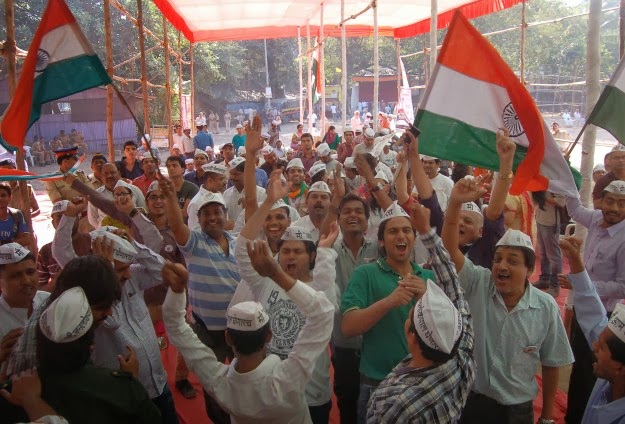
AAP workers celebrate at Mumbai's Azad Maidan (Pic: Imtiyaz Shaikh, Anadolu Agency)
NEW DELHI (AA) - In a clear indication of the political mood of the world’s largest democracy, Indians have chosen right-wing Hindu Nationalist Bharatiya Janata Party (BJP) over the ‘secular’ Indian National Congress party. 
The right-wing BJP has emerged as the single biggest party in four states whose election results were declared in gradual stages by the Election Commission of India. Retaining power in Madhya Pradesh (MP) and Chhattisgarh, BJP has upstaged Congress in Delhi and Rajasthan thus emerging a clear winner in the four states.
The counting of votes in North-Eastern state of Mizoram, the fifth state which went to polls in November, will begin tomorrow on Monday, December 9.
Poll pandits say that the election results in five states are likely to impact the next year’s general election to be held in May 2014.  
In Delhi, BJP has routed the ruling Congress which has been in power for  the last three terms.  Out of total 70 seats, BJP bagged 32 seats followed by political debutant Aam Aadmi Party (AAP means Common Man’s Party) with 28 seats and three-time ruling Congress party occupies third spot with merely 8 seats. BJP, though lacking clear majority, is likely to form the next government.
Delhi chief minister and Congress leader Ms. Sheila Dikshit, a political heavyweight and three-time chief minister was defeated by a newcomer Arvind Kejriwal, party chief of AAP. Sensing an imminent defeat, Ms. Dikshit  resigned as chief minister and sent her resignation to Delhi’s Lt. Governor Najeeb Jung even before the complete results were announced.  When asked by reporters whether Congress party has failed to gauge mood of the people in Delhi, she said, “Bewakoof hain na (we are idiots, right?)”.
Ms. Dikshit had recently described AAP as a “group of broom-wielding” men making fun of AAP whose election symbol is broom.
The biggest surprise of Delhi election has been the debutant politician Arvind Kejriwal whose AAP was formed barely nine months ago as he challenged the right-wing opposition party BJP and the ruling Congress party which has retained Delhi for past three terms.
Kejriwal is former government bureaucrat (tax inspector) who rose to prominence in recent years for spread-heading anti-corruption campaign along with popular social crusader Anna Hazare demanding a strong anti-corruption legislation.
Talking to reporters, Kejriwal termed his party’s success as a “historic win.”
“This election has been fought on the principles of honesty and truth. Common people have defeated the heavyweights. This is the strength of aa aadmi (common man),” he said referring to his party’s name, Common Man’s Party.
In central state of Madhya Pradesh (MP), the ruling BJP has retained power for the third time thus making the central state a stronghold of the right-wing party. Out of the total 230 seats, the right-wing party won 156 seats thus crossing the half-way mark of 115 to form the government. Congress  bagged only 53 seats, thus suffering a humiliating defeat. The BJP leads in 10 seats and Congress in 3 as the counting of votes is underway in some constituencies. 
The young Congress leader from MP Jyotiraditya Scindia conceded defeat of his party and said he is very disappointed with the results. He said MP chief minister and BJP leader Shivraj Singh Chouhan has triumphed dismissing the suggestion that Gujarat chief minister and BJP’s Prime Ministerial candidate Narendra Modi played any role in the right-wing party’s victory in MP. 
In Chhattisgarh state, initially there was a neck to neck fight between the ruling BJP and the Congress with the former getting 39 seats and the latter bagging 37 out of total 90 seats. The BJP leads in 8 constituencies while Congress in 4 as the counting of votes was not complete. Going by the trends, BJP is likely to retain Chhattisgarh with a narrow margin.
In the desert state of Rajasthan, the ruling Congress has been decimated by the BJP. Out of total 199 seats, BJP bagged 162 thus getting a thumping majority to form the government on its own. Congress was reduced to a rubble with mere tally of 21 seats.
Vasundra Raje, BJP leader and former chief minister of the state, said that Narendra Modi factor has played an important role in BJP’s victory. She told reporters that people of Rajasthan were impressed by Modi’s development in the neighbouring state of Gujarat. 
Congress President Sonia Gandhi and chairman of federal coalition UPA  (United Progressive Alliance) accepted the defeat of her party. In her statement, she said that the election results naturally call for “deep introspection”. She said that people were unhappy with the Congress party.
“We are very disappointed over the results. We congratulate our opponents for victory. We will introspect and take all necessary action to rectify,” she said.
“This result calls for deep introspection,” she said. "We have to understand to look at the many reasons for this defeat. We have to look into the way we did not take our message to the people,” she said.
Gandhi scion and Congress vice-President Rahul Gandhi also acknowledged defeat.
“The people have sent us a clear message. We have heard it... not just in our minds but in our hearts,” Gandhi said.

“The Aam Aadmi Party involved a lot of non-traditional people and we will learn from that...and will better it in a way you cannot imagine,” he said.

Thursday, December 05, 2013

India's federal cabinet clears draft bill for new Telengana state

A representative map of the proposed bifurcation of AP (Pic: IBNLive)
NEW DELHI (AA) - India’s federal cabinet has cleared the draft bill for the formation of a new South Indian state ‘Telengana’ to be carved out of Andhra Pradesh (AP) state, thus rejecting the proposal to include two more districts as against the original idea of 10 districts.
Several regional and national political parties had opposed the proposal to include two more districts into the newly-proposed state of Telengana.
Right-wing BJP, India’s main opposition party, andTelengana’s regional party TRS (Telangana Rashtra Samithi) had warned the ruling Congress party that they would severely oppose the extension of the proposed state.
NDTV, an English language news channel, reported that federal government’s decision was because of an ‘opinion exit poll’ which predicted a BJP victory in four of the five state elections whose decision will be declared on Sunday December 8.
Sources in federal government told Anadolu Agency that though the Telengana draft bill does not figure in the agenda of Parliament’s ongoing Winter Session (which began today) but assurance is being given that it can be expedited by the government. 
Earlier on Thursday, a massive strike and agitation was called by TRS leader Chandrasekhara Rao inTelengana region against the proposal of extending the proposed boundary of Telengana.
On Tuesday December 3, Rao, who championed the creation of Telangana state for years, told reporters that he is opposed to the proposal to include two additional districts in the proposed Telangana state.
On October 3, 2013, the federal government decided to create a new state by carving out a newly-proposed Telangana state out of the Andhra Pradesh (AP) state in South India.
AP consists of three regions: Telangana, Rayalaseema and Coastal Andhra, also referred to as Seemandhra. Rayalaseema and Seemandhra are bitterly opposed to the state’s division.
According to the original proposal, the federal government had decided that Telangana would consist of 10 districts only. The two additional districts Kurnool and Anantpur have sizeable Muslim populations and are very close to Hyderabad city, which will remain the joint capital for the two states for 10 years.
If the proposal of two additional districts had been accepted, the state of Andhra Pradesh would have been equally divided, each part getting 21 Lok Sabha (lower house of the Indian Parliament) seats and 147 seats in state legislative assembly.
Once the bill is passed in the Indian parliament, it will be sent to Indian President Pranab Mukherjee with the recommendation that he refer it to the AP’s assembly. The state assembly can provide feedback on the resolution but the federal government is not under any obligation to abide by it.

- Long struggle
Telangana was originally part of a princely state of erstwhile Nizam of Hyderabad.
A year after its independence in 1948, India put an end to the rule of Nizams and a Hyderabad state was formed.
In 1956, the Telangana part of Hyderabad was merged with the AP state.
The people from Telangana were against merger with AP fearing unemployment because the education levels and development in AP were better than in Telangana.
There were cultural differences as well.
The culture and language in Telangana bore influences of North India.
In 1969, the Telangana movement intensified under the leadership of Marri Chenna Reddy and the Telangana Praja Samithi.
There was widespread violence and over 350 protesters were killed in police firing.
However, the movement could not last long as Reddy went on to merge his party with the Congress Party and was eventually made chief minister by then Prime Minister Indira Gandhi.
The movement was revived again in 2001 when K Chandrasekhar Rao quit the Telugu Desam Party and formed the Telangana Rashtra Samithi (TRS) for the formation of a Telangana state.
In 2004, the Congress Party joined hands with Rao, promising separate Telangana but later backtracked.
In 2009, Rao’s fast unto death forced then federal home minister P Chidambaram to announce the creation of a separate state of Telangana.

But the formation was delayed by the federal government of the time.
Anadolu Agency, December 5, 2013

India’s top court indicts former judge in sexual harassment case

Retired Supreme Court judge AK Ganguly (Pic: Supreme Court of India)
NEW DELHI (AA) - India’s top court has indicted its retired judge AK Ganguly in a case of sexually harassing a law intern who interned with him in 2012.
The three-member Supreme Court committee, which investigated the allegation of sexual harassment, said that they found evidence of “unwelcome verbal/non-verbal conduct of sexual nature.”
However, P Sathasivam, the Chief Justice of India, said the committee decided that “no further follow-up action is required” because the woman’s internship with Justice Ganguly was a private placement and he had retired from Supreme Court by the time charges against him were levelled.
AK Ganguly currently serves as chairman of West Bengal Human Rights Commission, a state rights body. He has refused to quit the post amid calls by lawyers and activists for his resignation after Supreme Court indicted him.
The case came to light last month when the alleged victim, the law graduate wrote a blog accusing the judge (without naming him) of sexually harassing her while she interned with him in 2012.
In her blog, she wrote, “In Delhi at that time, interning during the winter vacations of my final year in the University, I dodged police barricades and fatigue to go to the assistance of a highly reputed, recently retired Supreme Court judge whom I was working under during my penultimate semester.”
“For my supposed diligence, I was rewarded with sexual assault (not physically injurious, but nevertheless violating) from a man old enough to be my grandfather,” she alleged.
The Supreme Court had formed a three-member committee to investigate the charges. The intern appeared before the committee to record her statement, requesting that the committee to maintain the confidentiality of her testimony. Ganguly’s statement was also recorded by the inquiry panel before submitting its report on November 29, in which the name of the judge was revealed. 
Ganguly had dismissed the sexual harassment charge.
“I deny all the charges,” Ganguly had told an English private news channel.
“She came to my house on a number of occasions. The intern is like a child to me. The intern has worked with me, but she has never raised the issue with me,” he had said.
The inquiry into Justice Ganguly began only days before a top journalist Tarun Tejpal was accused of raping a junior colleague during a high-profile media event in coastal state of Goa between November 7-8. Tejpal remains in police custody after a court rejected his anticipatory bail plea.

The two cases have sparked a national debate over men in positions of power violating women in the workplace.

40 children dead due to cold at India riot relief camps

A child is buried at a relief camp in Muzaffarnagar (Pic: Indian Express)
NEW DELHI (AA) - Just three months after the killing of at least 50 people in communal riots between Hindus and Muslims in Muzaffarnagar in the northern state of Uttar Pradesh (UP), death returns to haunt the displaced families of the riot victims in a quieter and different form. With the onset of an extreme winter, the cold has claimed over 40 lives, most of them children, reports the English-language daily Indian Express though government officials have denied "irregular deaths".
Zafarul Islam Khan, president of All-India Muslim Majlis-e Mushawarat (AIMMM), an umbrella organisation of Indian Muslims, slammed the UP state government for the complete denial of the children’s death as a result of cold.
"It’s a matter of shame for the government," Khan told Anadolu Agency from Muzaffarnagar which he visited today to oversee relief and documentation work.
Khan said the children including infants died because of cold, fever, pneumonia, and hunger.
"There is no proper medical facility at the relief camps. The displaced victims of the riots can’t even afford a fee of Rs. 100 by an ordinary doctor," he said.
Khan said that there is no adequate ration for the relief camp residents as government had stopped supplying food grains from the month of November.
He said that there are at least 15,000 people still living in makeshift tents.
Today was Khan’s fifth visit of the relief camps.
Earlier on November 27, a delegation from the AIMMM visited the relief camps along with social workers and journalists. The delegation distributed 300 woolen duvets and mattresses worth rupees 250,000.
The government officials have questioned the veracity of the deaths being reported.
"These claims of so many deaths appear to be false. If there was even a single death, the local press would have been alerted. In any case, neither the affected families nor the organisers of the camps informed us about these deaths. So how do we establish the cause of death in retrospect?" the Indian Express quoted Shamli District Magistrate P K Singh as saying.
Singh said that teams of doctors would be sent to conduct a survey.
"Doctors have been making periodic rounds of the camps, but now we will ask them for detailed reports. Any health concerns of the people will be addressed," Singh told the Indian daily.
Khan, the AIMMM's president, severely questioned the government official’s denial and said that from the day one government has been misleading and lying to the nation on Muzaffarnagar riots and its aftermath.
"The government says only one relief camp exists today. You come to Muzaffarnagar and I will show you at least two dozen relief camps," Khan said sternly.

In a spate of violence that broke out on September 7, at least 50 people were killed in Muzaffarnagar and neighboring towns and villages after a Muslim man was killed by the brother and cousin of a Hindu girl after allegedly harassing her. The two killers -- from the Hindu Jat community -- were reportedly lynched by the family of the slain Muslim and others in the locality.